 by
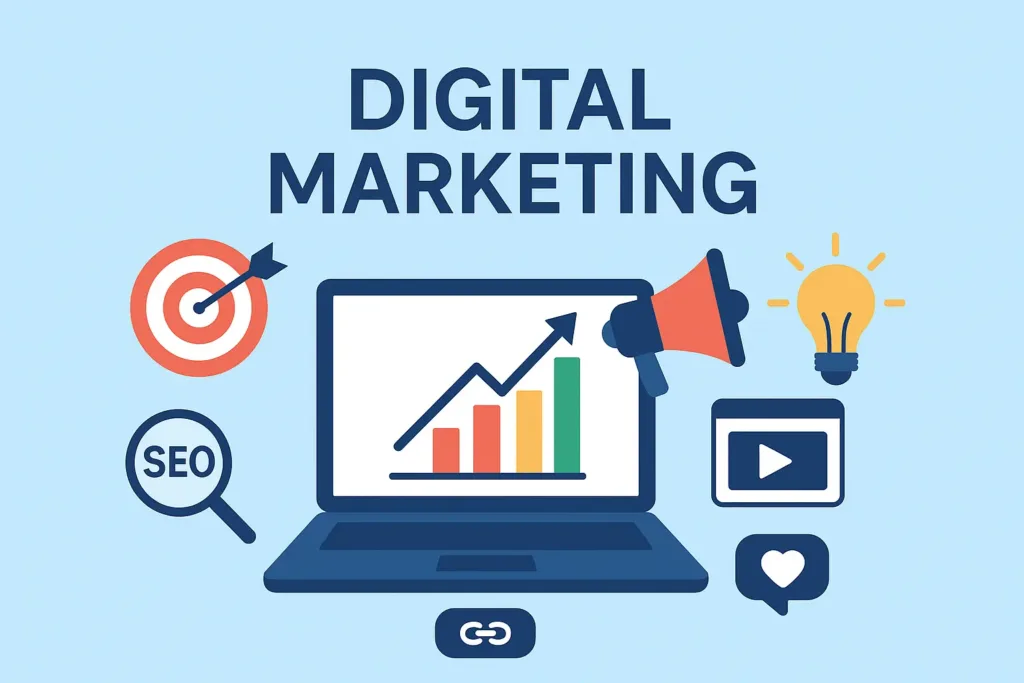
by What is the Digital Marketing : Digital marketing is the process of promoting a brand, good, or service through the application of digital channels like websites, email, social media, and search engines. It entails producing and disseminating content that is specifically intended to draw in and interact with a certain audience in order to enhance online traffic, lead generation, sales, and brand exposure. In contrast to traditional marketing strategies, digital marketing uses a variety of tactics such as search engine optimization, SEO, blogging, marketing on social media, marketing via email, and online advertising to contact clients more effectively and personally.
Benefit of Digital Marketing

The vocabulary and language used in the field for digital marketing is referred to as “digital marketing language.” It contains words and ideas on tactics, platforms, technologies, and strategies used in online marketing. Typical subjects discussed in terms of digital marketing include:
- The process of making improvements to a website to raise its position on the the results pages of search engines is known as search engine optimization, and SEO.
- Online advertisers who use the pay-per-click (PPC) model must fork out a certain amount each time a user clicks on their advertisement.
- Social media marketing is the practice of promoting goods and services through social media platforms.
- Sending promotional emails to a specific audience is known as email marketing.
- The process of producing and disseminating worthwhile content in order to draw in and keep a target audience.
- Increasing the proportion of website visitors who complete a desired action is known as conversion rate optimization, or CRO.
- KPIs, or key performance indicators, are metrics that are used to assess how well digital marketing efforts are working.
- Advertising to consumers who already visited a web page and interacted by a brand is known as retargeting.
- A/B testing is the process of contrasting two iterations of a website or advertisements to see which works better.
- Influencer marketing is the practice of promoting an item or service on social media by partnering with well-known people.
These are merely a few instances of subjects that are frequently covered in discussions using the terminology of digital marketing. Within the sector, this language for efficient communication and teamwork.
Read More: advanced digital marketing training Faridabad
Best 5 Role Of Digital Marketing
Digital marketing is no longer a supplementary function in business—it has become the backbone of modern commerce. With technology evolving rapidly, businesses are leveraging digital marketing not just for promotion but for strategic growth, customer engagement, and revenue generation. As we move further into the 2020s, the landscape of digital marketing is transforming, creating new roles and career opportunities for professionals.
In this article, we’ll explore the best five roles of digital marketing in the future, why they matter, and how they will shape businesses and careers.
1. Digital Marketing Strategist: The Master Planner
A Digital Marketing Strategist is responsible for planning, implementing, and overseeing digital campaigns that align with a company’s overall goals.
Key Responsibilities:
- Creating data-driven strategies for SEO, PPC, content, social media, and email campaigns.
- Conducting market research and competitive analysis to identify opportunities.
- Coordinating with designers, content creators, and analysts to ensure campaigns are cohesive.
- Using AI and analytics tools to predict trends and optimize campaigns in real-time.
Why This Role Will Be Crucial in the Future:
The future of digital marketing is data-driven and AI-powered. Strategists who understand analytics, customer behavior, and automation tools will be highly sought after. Companies will increasingly rely on these professionals to make strategic decisions that directly impact revenue, rather than just running campaigns blindly.
Skills Required:
- Strong understanding of SEO, PPC, content marketing, and social media.
- Knowledge of analytics tools like Google Analytics 4, SEMrush, Ahrefs, and AI-powered marketing tools.
- Strategic thinking and creativity.
- Project management and leadership abilities.
2. Content Marketing Specialist: The Storyteller of the Digital Age
Content is still king, and the Content Marketing Specialist ensures that businesses communicate effectively with their audience.
Key Responsibilities:
- Creating blogs, social media posts, videos, infographics, podcasts, and other digital content.
- Optimizing content for SEO and user engagement.
- Planning content calendars aligned with marketing campaigns.
- Using AI-based tools to analyze trends, optimize content, and generate ideas.
Future Trends in This Role:
- AI content generation tools (like ChatGPT, Jasper, and Content AI) will help specialists produce high-quality content faster.
- Interactive content (quizzes, polls, AR experiences) will dominate customer engagement.
- Storytelling will shift from just selling products to building authentic brand experiences.
Skills Required:
- Excellent writing and storytelling skills.
- Knowledge of SEO and content optimization.
- Familiarity with AI tools for content creation and analytics.
- Creativity and adaptability to new formats and platforms.
3. Social Media Manager: The Digital Brand Ambassador
Social media is the primary touchpoint for most consumers today. A Social Media Manager ensures a brand’s presence is strong, engaging, and responsive.
Key Responsibilities:
- Creating and scheduling posts across platforms like Instagram, Facebook, LinkedIn, Twitter, TikTok, and YouTube.
- Managing community engagement, responding to customer queries, and monitoring feedback.
- Running paid social campaigns to increase reach and conversions.
- Using analytics to track performance and optimize campaigns.
Future Trends in This Role:
- Short-form video content will dominate social engagement. Platforms like TikTok, Instagram Reels, and YouTube Shorts are expected to be central to marketing strategies.
- AI tools will automate post scheduling, trend analysis, and even content suggestions.
- Influencer partnerships will grow, requiring managers to coordinate campaigns with micro and nano-influencers.
- Social commerce will increase: direct product sales through social media platforms will become more common.
Skills Required:
- Social media expertise across multiple platforms.
- Analytics and reporting skills.
- Creativity in visual and written content.
- Knowledge of emerging technologies like AR, VR, and AI-based marketing tools.
4. SEO & SEM Specialist: The Visibility Expert
Search Engine Optimization (SEO) and Search Engine Marketing (SEM) specialists ensure that a business is visible to the right audience at the right time.
Key Responsibilities:
- Performing keyword research and competitive analysis to identify growth opportunities.
- Optimizing websites and content for search engines (on-page and off-page SEO).
- Running paid search campaigns (Google Ads, Bing Ads) to capture high-intent traffic.
- Monitoring performance metrics and updating strategies to maximize ROI.
Future Trends in This Role:
- Voice search and AI-powered search will become mainstream. Specialists will need to optimize content for natural language queries.
- Mobile-first indexing and page experience metrics will influence search rankings more than ever.
- AI tools will assist in keyword research, content optimization, and predictive search analytics.
- The role will increasingly involve technical SEO, including site architecture, schema markup, and server optimization.
Skills Required:
- Strong understanding of Google algorithms, analytics, and search trends.
- Expertise in tools like SEMrush, Ahrefs, Moz, and AI-based SEO software.
- Analytical mindset to measure and improve campaign performance.
- Knowledge of UX, web development basics, and mobile optimization.
5. Digital Marketing Analyst: The Data Interpreter
The Digital Marketing Analyst is responsible for understanding performance data and translating it into actionable insights.
Key Responsibilities:
- Collecting and analyzing data from multiple digital channels (website, social media, email, ads).
- Measuring ROI, engagement rates, conversion rates, and other KPIs.
- Creating dashboards and reports for stakeholders to guide marketing decisions.
- Using predictive analytics and AI to forecast trends and consumer behavior.
Future Trends in This Role:
- AI and machine learning will automate much of the data collection and initial analysis. Analysts will focus on strategy and insights rather than manual reporting.
- Cross-channel analytics will become standard, integrating social, web, email, and offline data.
- Data privacy regulations will require analysts to be skilled in ethical data handling.
Skills Required:
- Expertise in analytics tools like Google Analytics, Tableau, Power BI, and AI-based reporting platforms.
- Strong quantitative and analytical skills.
- Knowledge of digital marketing channels and metrics.
- Ability to communicate insights effectively to non-technical stakeholders.
🔹 Additional Emerging Roles in Digital Marketing
While the five roles above are crucial, the future of digital marketing will also see the rise of:
- AI Marketing Specialists: Experts in leveraging AI for campaigns, chatbots, and predictive analytics.
- Marketing Automation Managers: Professionals who implement tools like HubSpot, Marketo, or Salesforce to streamline campaigns.
- UX/UI Marketers: Combining marketing with design to ensure a seamless digital customer experience.
- E-commerce Marketing Specialists: Focused on selling products directly via digital channels.
These roles will complement the core five and make digital marketing an even more data-driven, strategic, and creative field.
Why Digital Marketing Roles Will Be More Important in the Future
- Customer Behavior is Online: Most purchasing decisions start online. Businesses must be visible, engaging, and responsive digitally.
- AI and Automation: Automation tools reduce manual work but increase the need for strategic oversight and analytics.
- Competitive Advantage: Companies that leverage digital marketing effectively can outperform competitors, regardless of size.
- Global Opportunities: Digital marketing allows businesses and professionals to reach audiences worldwide, creating more career opportunities.
- Data-Driven Decisions: The ability to analyze data and optimize campaigns ensures higher ROI and smarter marketing investments.
Conclusion
The future of digital marketing is dynamic, data-driven, and technology-focused. The top five roles—Digital Marketing Strategist, Content Marketing Specialist, Social Media Manager, SEO & SEM Specialist, and Digital Marketing Analyst—are essential for businesses that want to stay ahead of the competition.
Aspiring professionals who master these roles will not only secure rewarding careers but also help businesses achieve measurable growth in an increasingly digital world.
By combining creativity, strategy, and technology, digital marketers will shape the future of commerce and customer engagement, making these roles invaluable for the next decade.

More Info: dmapu.com
Studying at DMAPU India is a Great Experience
Studying at DMAPU India is more than just learning digital marketing—it’s an experience that transforms your career. Students here get access to industry-focused training, practical projects, and expert mentorship that make learning both engaging and result-driven.
One of the biggest highlights is the hands-on exposure. Instead of just theory, learners work on real campaigns, live projects, and the latest marketing tools used by top agencies worldwide. This ensures that every student not only understands concepts like SEO, Google Ads, Social Media Marketing, and Content Strategy but also knows how to apply them in real business situations.
Another reason why studying at DMAPU India feels like a great experience is the supportive learning environment. Trainers are approachable, classes are interactive, and students are encouraged to ask questions, share ideas, and collaborate. Whether you’re a beginner or a working professional, the personalized guidance helps you grow with confidence.
Most importantly, DMAPU India provides 100% job placement assistance, career counseling, and continuous support even after course completion. Many students call it a life-changing journey because it not only helps them gain skills but also opens doors to high-paying jobs, freelancing opportunities, and entrepreneurship.
👉 In short, studying at DMAPU India is an experience of growth, learning, and career success—a perfect blend of knowledge and opportunity.
The future of digital marketing is less about hard selling and more about human connection powered by technology. Whether it’s SEO strategists, social media community builders, data interpreters, automation specialists, or immersive experience creators—these roles will define how brands and people connect in the coming years.
If you’re thinking about a career in digital marketing, the best time to start learning is now. Tomorrow’s roles will need people who can balance creativity with analytics, empathy with technology, and storytelling with strategy.